Tag: Local Food
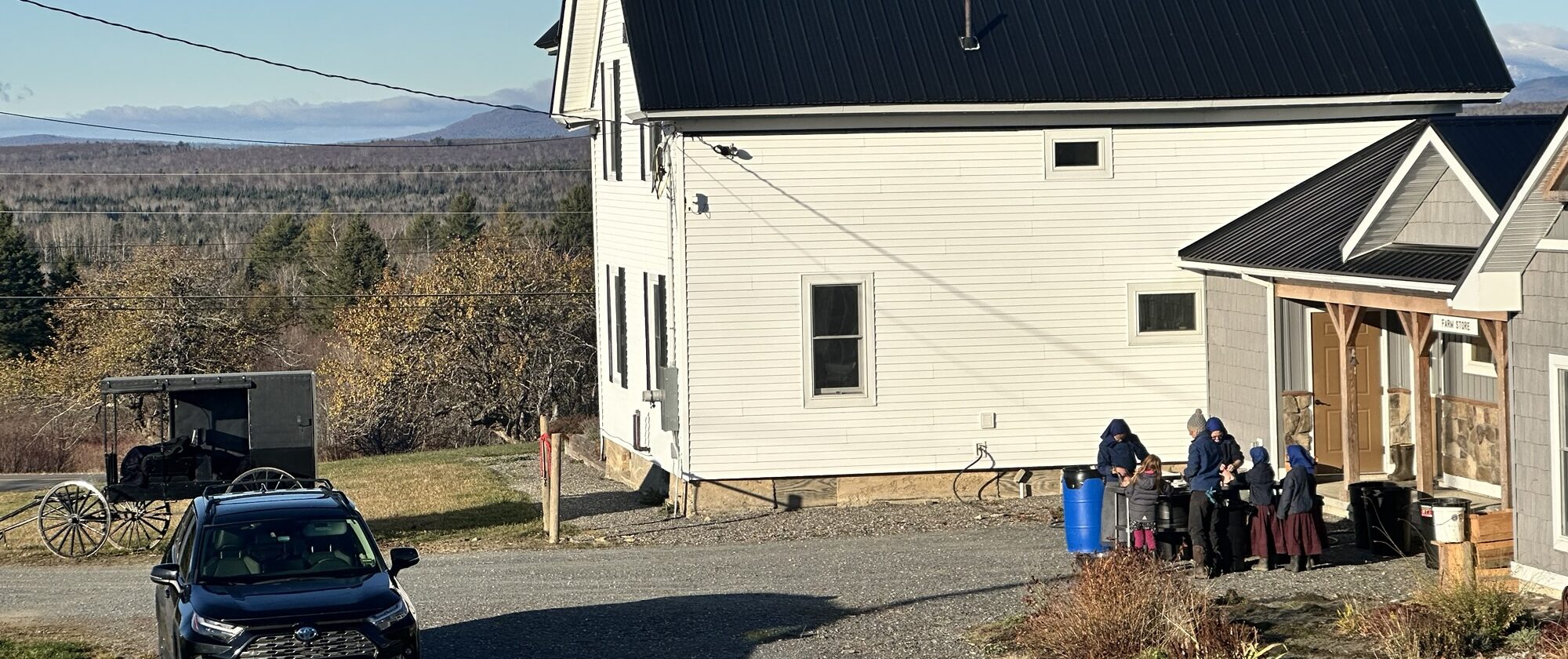
On Butchering Day & Community Food
The Miller Family rarely travels as one. I assume this is a result of enjoying their home, and also because a crew that includes 9 littles spread across the last 10 years is tough to get out the door. We know when they travel, since they pass our Farm to get about anywhere, and often borrow our horsepower. It’s Church every-other Sunday, a few social trips a year and butchering days here at the Farm—the latter outnumbering the former.
Up at the killing area, Menno and I find a steady rhythm of kill, scald and pluck, with me swapping between wielding the knife and running the plucker while Menno dunks each bird into the 154-degree scald bath. Liz, Mary and the Lydia, Menno’s niece from New York who is here as the teacher at their schoolhouse, setup shop in our dooryard outside the Farm Kitchen. Here, they handle the evisceration, before moving inside for final cleaning, packaging, and labeling.
The children fan out, balancing play with finding tasks and being found for others. Mose, with ear tips pink below the brim of his hat, pounces on an escaped bird. Becky reaches into the ice water filled barrel, pulls a chicken out by its leg and uses the weight of the bird to flex the leg joint and cut away the foot which she tosses into a bucket for Liz to turn to stock. Once plucked chickens need transport down the hill for further processing. We call in the cavalry and Ellie, Lydia*, Maddie, Katie, Andy and the others previously mentioned come running, grabbing one or two handfuls of chicken leg each and running the now naked birds down the hill where their short journey from field to freezer will be completed. Sometimes I’ll watch as they trudge back up the hill with a grin on their faces as if pulling sleds in anticipation of another toboggan run, only their reward is another handful of chicken to transport. It doesn’t seen to make a difference to them. Sometimes, they disappear and I find out later they were taking turns warming themselves in the boiler room.
*Menno’s oldest daughter, not the niece/school teacher. Same names make Amish a challenge to write about. I suspect there’s purpose behind this; something I may work into my writing some other time.
Reflecting on the help and play of the Children brings to mind a quote from Wendell Barry’s writing which I will share below. If you are unfamiliar with Barry, you can start getting to know him in this article. I’ll quote him often as his writing (which I’ve been devouring as of late) is an inspiration and puts the work of small scale farming, and much more, into words better than most anyone.
From his Essay Economy and Pleasure first found his collection of essays What are People For.
On many days we have had somebody’s child or somebody’s children with us, playing in the barn or around the patch while we worked, and these have been our best days. One of the most regrettable things about the industrialization of work is the segregation of children. As industrial work excludes the dead by social mobility and technological change, it excludes children by haste and danger. The small scale and the handwork of our tobacco cutting permit margins both temporal and spatial that accommodate the play of children. The children play at the grownups’ work, as well as at their own play. In their play the children learn to work; they learn to know their elders and their country. And the presence of playing children means invariably that the grown-ups play too from time to time.
It’s worth noting that if it weren’t for the help of the Children, we’d be using the tractor. Once out of the plucker, chickens would go into ice water, a plastic barrel on a pallet transported down the hill on the forks of the tractor 20 or so birds at a time. The technology is not an improvement.
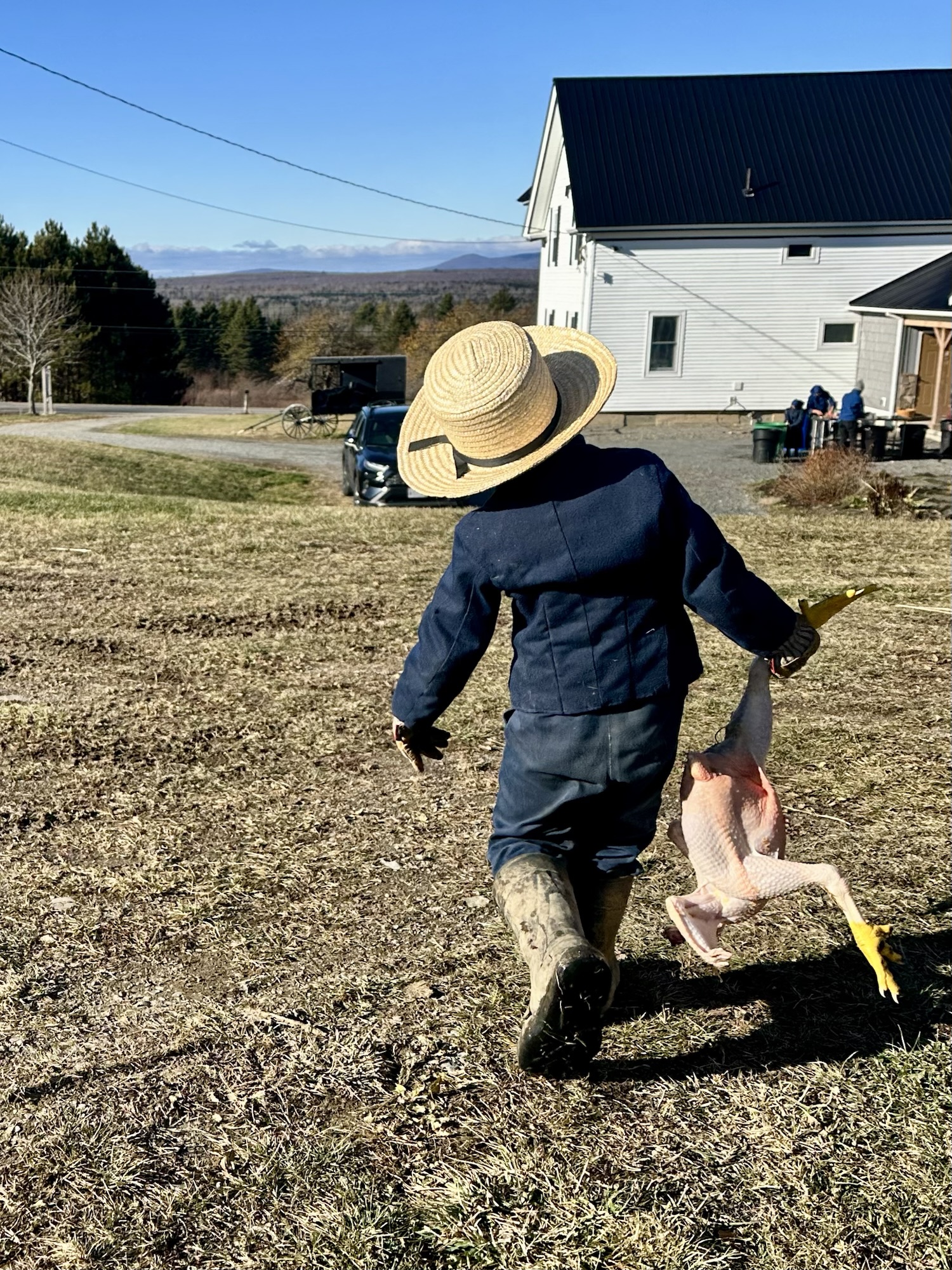
Butchering days start after dark the night before with the gathering and crating of chickens in the field. It begins again before sunrise the morning of as one of us heads out coffee still in hand to fill scalder and start it warming before we hustle through morning chores with a little more urgency than usual. Once the main task is done, there’s cleanup and disinfecting, equipment to put away, offal and feathers to stir into the compost, stock to simmer and can, evening chores, and if we’re lucky a hot dinner and warm shower before bed. Ok, definitely a shower before bed. This is all to say that butchering day is a full day, that spills into the day before and the day after. Liz, Ellie and I could not do it without help and in our 10 years of raising chickens for the table, we’ve never been without the best help. These helpers and the aura of community coming together to lend a hand for local food, make these days some of my favorite of the year.
Kill, scald and pluck, Menno and I discussions drift along like the clouds overhead in the cold November breeze. We of course discuss the chickens— how this round appears smaller . We speculate on the reasons; the cold weather, the size of the group, the recent droughts effect on the pasture and the challenges of keeping fresh water unfrozen this late in the season. We talk about his portable sawmill on order, a much anticipated new endeavor for him. We look forward to finishing up our falls tasks in preparation for winter, freeing us to do other pleasurable work, most notably taking our horse teams into our woodlots to harvest sawlogs to feed his new mill. I find out that it’s the Twins’ (Maddie and Mose) 8th Birthday, and I make sure to give them each well wishes as I hand them the gift of more chickens to run next time they arrive up the hill. Once they are off Menno sighs, and remarks that this day is almost identical to the day they were born. I can tell he is searching for words as he says little without thought. Finally he finds them and shares what a blessing it was, having healthy twins born at home on a beautiful late fall day with no complications. We continue; kill, scald, pluck.
Once the chickens are all down the hill, we move to the Turkey’s. Much larger, their strength is hard to contain in death and we work together to restrain their wings after the death blow is delivered. Two grown men, shoulder to shoulder, straining to restrain the birds in their final moment feels as personal a connection to the process of one’s food as you can get. It’s not fun, but necessary as the stainless steel cones used for the chickens aren’t nearly large enough. We discuss investing in larger cones for the Turkey’s, a likely purchase for next year if our trial run of Turkey’s for this Thanksgiving is deemed a success. I realize this may be a graphic description of the process, but I take pride in the humanity of it and the fact that our process still resembles agriculture, as opposed to the industry of .99 cent per pound factory Turkey’s mass produced by global organizations.
We move the Turkey’s down to the dooryard for gutting. Liz, Mary and Lydia the school teacher, have moved into the Farm kitchen where they are packaging the last of the chickens. As the last of the birds to reach the freezer, they stand on the porch for a break as Menno and I begin gutting the turkeys. “You men are slow. We’re waiting on you.” Mary quips. “Our job is done, they’re all killed and plucked,” I shoot back. Menno adds that we’re doing their job now. The banter continues and even Lydia the school teacher, a young newcomer to our unique group, joins and tells us that the women have been doing two jobs, gutting and packaging, to the men’s one. I count kill, scald and pluck as three tasks while pointing out that the men have been outnumbered two adults to their three as the teasing devolves to the women counting the removal of each organ as an individual task.
Eventually, I send Ellie to the barn followed by a group of her friends, the Miller kids, to get our horse Chip in from the pasture. Menno and Mary will be taking Chip this afternoon for an errand to town, leaving their horse in our barn from some needed rest while giving Chip some good work. Once they’re gone, Liz and I finish cleaning up and begin tidying the Farm for upcoming snow.
My shadow is long in the pasture as I roll portable fence rope and pull fiberglass posts from the ground, disassembling the chicken pasture as we are done with meat birds for the season. I pull turkey feet from my pockets and toss them to the farm dogs, a chewy treat and reward for keeping the livestock safe. My back is to the road as I hear the familiar clip-clop of hooves echoing from up the road. I turn and see Menno’s head leaning from his buggy, his face covered by the brim of his hate as a hand reaches out in a wave while the other holds the reigns tied to our horse. Having delivered the school teacher and children home, he and Mary are off and their errand. They won’t be back until well after dark, when they’ll swap our horse for theirs in the barn before their final 2-mile trot for home.
From Wendall Barry’s 1988 Iowa Humanities Lecture, The Work of Local Culture.
A good community, as we know, insures itself by trust, by good faith and good will, by mutual help. A good community, in other words, is a good local economy. It depends upon itself for many of its essential needs and is thus shaped, so to speak, from the inside—unlike most modern populations that depend upon distant purchases for almost everything, and are thus shaped from the outside by the purposes and the influence of salesmen.
If you’ve reach this far, I suppose I will let you know that we do have turkeys, chickens and other food from the Farm for sale here at the Farm. Stop in and see us anytime, or send us a note on one of our socials to make arrangements.